
Why Bias-Free News Is a Technology Problem — And How AI Is Finally Solving It
Most news platforms are engineered to maximise your time on screen, not your understanding of the world. The solution isn’t better journalism — it’s better architecture.
Last week, a reader named Ronak sent us an email. Not a bug report. Not a feature request. Just three sentences to say thank you — for news that felt complete, clear, and free from the invisible filters that quietly shape what most platforms choose to show you.
It stopped our entire team. Because what Ronak described — news free from human bias, blunt and fact-based — is not just a reader preference. It is the original promise of journalism, one that modern information technology has systematically broken, and that AI now has a genuine opportunity to restore.
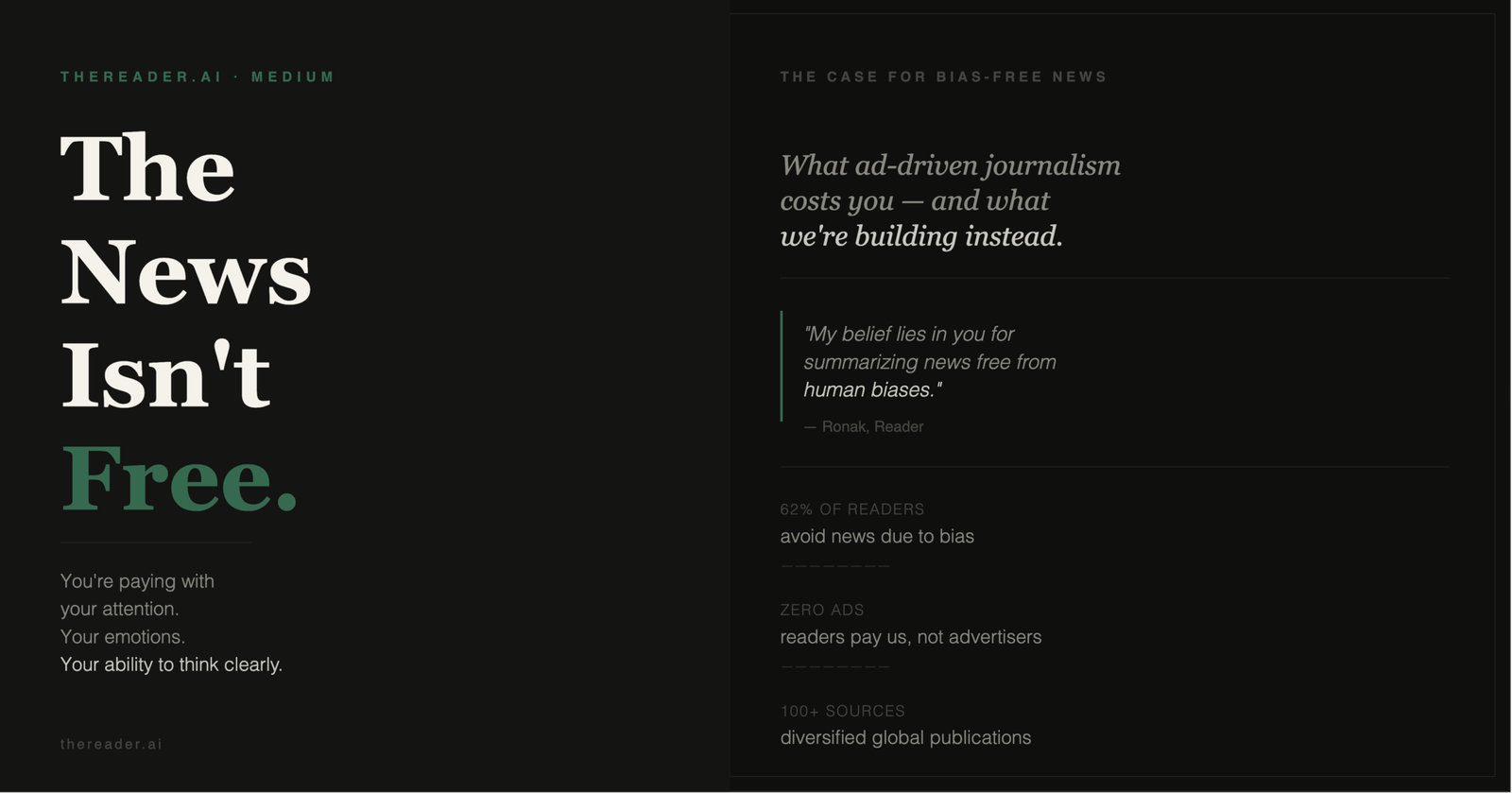
“My belief lies in you for summarizing news free from human biases and as blunt and fact-based as possible.”
— Ronak, Reader, TheReader.AIThis post is about that promise — what broke it, what it takes to rebuild it, and why the answer is fundamentally a technology problem rather than an editorial one.
The Delivery Problem Nobody Is Talking About
The raw material of news has never been more abundant. Every minute, thousands of journalists across hundreds of publications are reporting, verifying, and publishing. Events are covered from more angles, in more languages, from more geographies than at any point in human history.
And yet most readers feel less informed than ever. A 2022 Reuters Institute study found that over 60% of people in surveyed markets actively avoid news — not because they don’t care about the world, but because it leaves them feeling confused, manipulated, or exhausted.
The problem is not a shortage of information. The problem is delivery architecture — the systems and algorithms that sit between raw reporting and the reader, deciding what reaches you, in what form, and in what sequence. Those systems were not designed to maximise your understanding. They were designed to maximise your time on platform. And those two objectives point in opposite directions.
How Recommendation Algorithms Reshape What You Know
When a content algorithm selects which stories surface in your feed, it is making thousands of decisions per second based on one primary signal: what keeps you engaged longest.
Engagement is not the same as understanding. In fact, research consistently shows they are frequently in conflict. Content that confirms existing beliefs is more engaging than content that complicates them. Stories with clear causes are more engaging than stories with systemic ones. Urgency is more engaging than context.
So an algorithm optimised purely for engagement will — without any human intent to mislead — systematically surface content that is confirming, simplified, and urgent over content that is challenging, nuanced, and slow-moving. Not because anyone decided to distort reality. Because the mathematics of attention reliably reward those properties at scale.
“The bias in modern news is not primarily editorial. It is algorithmic. And algorithmic bias is invisible, scalable, and relentless.”
A reader whose information diet is shaped by such a system gradually develops a model of the world that is systematically skewed — not toward any viewpoint, but toward a particular emotional and cognitive register: urgent, certain, simplified. This is not a bias you can fix by reading more. It is embedded in the mechanism of delivery.
The Source Diversity Problem Most Aggregators Ignore
Most news aggregators claim to offer diverse coverage. What they actually offer is diverse presentation of a narrow source pool.
The majority of what you read — regardless of which platform surfaces it — originates from a small cluster of major wire services and large-circulation publications. Those outlets do excellent work. But they share structural similarities: similar editorial cultures, similar geographic concentrations, similar assumptions about what constitutes a newsworthy event.
When every aggregator draws from the same upstream sources, source diversity is an illusion. You are reading the same information packaged in different formats.
What genuine source diversity looks like
-
01Regional and local publicationsCover stories that major outlets systematically deprioritise because they lack broad national appeal, even when they carry significant local or sector impact.
-
02International publications with independent editorial culturesFrame global events from genuinely different vantage points — not just different opinions about the same set of facts, but different facts entirely.
-
03Specialist domain publicationsCover technology, science, economics, and policy with depth that generalist outlets cannot sustain on deadline.
-
04Emerging-market and underrepresented-geography sourcesSurface what is happening in places that major Western publications cover intermittently at best.
When you read the same event through genuinely different lenses — not just different opinions, but different information — your understanding changes fundamentally. You stop seeing the story and start seeing the shape of what each version leaves out. That gap is where real knowledge lives.
What AI Should Actually Do for News
There is significant noise in the conversation about artificial intelligence and journalism. Much of it conflates two very different applications of the technology, with very different implications for readers.
The first application — and the more common one today — is AI used to generate more content faster. Higher volumes of articles, summaries, and headlines at lower production cost. This application benefits platforms economically. It does nothing for readers. It produces more material without improving the signal-to-noise ratio that is already the core problem.
The second application — which is what we have built at TheReader.AI — uses AI to do the inverse: not to generate more, but to distil better.
The three things AI can do that humans cannot at scale
-
01Cross-source triangulationRead across hundreds of independent publications simultaneously and identify what is consistent — the verified, corroborated core — versus what varies by outlet. Variation is not always bias; sometimes it is legitimate interpretation. But making it visible gives readers the ability to distinguish the two.
-
02Fact-interpretation separationEvery piece of journalism contains both verified facts and editorial interpretation. These are both valuable, but they are not the same thing. AI can help separate these layers at scale — giving readers the factual foundation clearly, with interpretation clearly labelled as such.
-
03Comprehension-optimised summarisationA summary designed for comprehension tells you what happened, what is confirmed, what remains uncertain, and what context is needed. This is structurally different from a summary designed to generate a click or a reaction — and AI makes it possible to deliver the former consistently at scale.
The Three Properties of News Technology That Actually Serves Readers
After building and iterating on TheReader.AI, we have identified three properties that distinguish information technology genuinely serving readers from technology that merely claims to.
Completeness over selection. The goal is not to find you stories you will most enjoy or most engage with. It is to give you an accurate and complete picture of what is happening — including the stories that are important but unsexy, slow-moving rather than urgent, or complex rather than clear. Completeness is harder to optimise for than engagement. It is also the only property that produces genuinely informed readers.
Source breadth over source depth. Depth within a single source or editorial tradition produces confident readers who may not be accurate ones. Genuine breadth — across geographies, specialisms, and editorial approaches — produces readers whose understanding is more resistant to the blind spots any single source carries. The two feel different. Depth feels satisfying. Breadth feels complicated. Complicated is often closer to accurate.
Separation of fact from interpretation. Presenting facts and editorial interpretation as a seamless whole is how readers end up consuming conclusions when they thought they were consuming information. Technology that clearly separates these layers — even imperfectly — gives readers more agency over their own understanding.
Frequently Asked Questions About Bias-Free News Technology
No AI system is perfectly neutral — all models are trained on human-generated data and carry some inherited characteristics. The meaningful question is not whether AI can eliminate bias entirely, but whether it can reduce the systematic biases that current delivery architectures introduce. By optimising for comprehension rather than engagement, drawing from genuinely diverse sources, and separating facts from interpretation, AI can produce significantly cleaner information than systems optimised for time-on-platform.
Editorial bias is a conscious or unconscious tendency in how a publication frames, selects, or emphasises stories based on its values or viewpoint. Algorithmic bias is the systematic distortion introduced by recommendation systems optimising for engagement signals. Both affect what you read, but algorithmic bias is more pervasive because it operates invisibly across all platforms simultaneously and compounds over time as systems learn your engagement patterns.
When the same event is reported by independent publications with different editorial cultures and geographic perspectives, comparing their coverage reveals both what is consistently verified and where interpretations diverge. This triangulation approach — reading across sources rather than deep within a single one — is the closest practical approximation to a complete picture that technology can deliver at scale.
Because they are optimised for engagement, not understanding. Engagement metrics reward emotionally activating content — urgency, conflict, certainty. Understanding requires nuance, context, and complexity — all of which score poorly on engagement metrics. A platform optimised for engagement will systematically deliver an emotionally intense but informationally incomplete version of reality.
The Only Metric That Matters
We use one internal benchmark at TheReader.AI that we have found more useful than any engagement metric: does a reader who spends fifteen minutes with our platform have a more accurate model of the world than they did before?
Not a more opinionated model. Not a more alarmed one. Not a model that has been confirmed or challenged along any particular dimension. A more accurate one.
That is hard to measure directly. It is also the only thing worth measuring. Because the downstream consequences of people having accurate models of the world — better decisions, more productive conversations, more resilient understanding — are the actual value that news technology should be delivering.
Ronak’s email told us we are moving in the right direction. Not because he was satisfied, but because he felt he was understanding more clearly. Those are different things. Satisfaction is easy to manufacture. Clarity takes architecture.
That is what we are building — one story, one summary, one reader at a time.
Read news the way it should be.
Hundreds of sources. Zero spin. One clear picture.