
How fake news on WhatsApp quietly divides Indian families, and how to stay informed without losing the people you love.
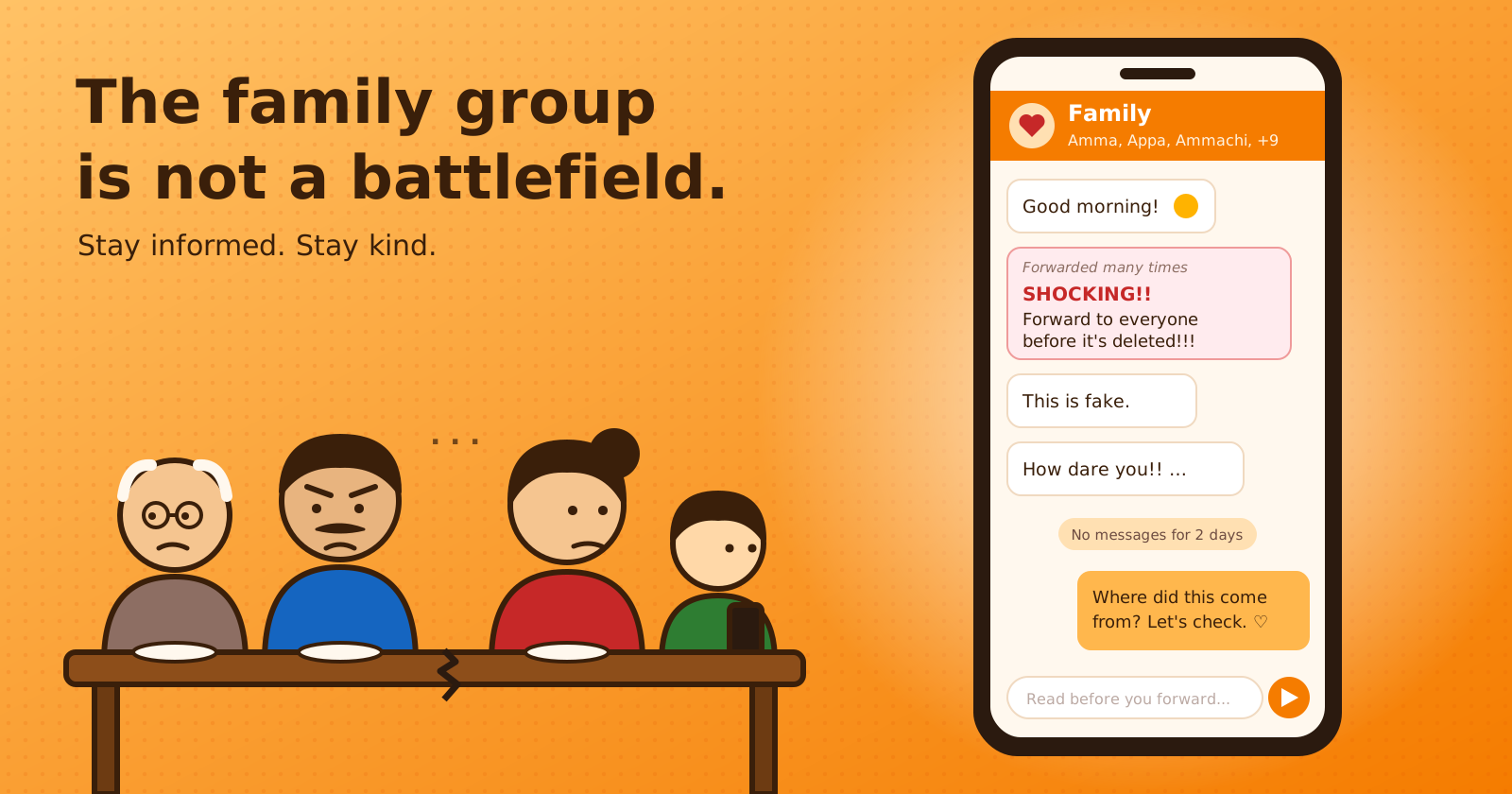
There’s a particular kind of silence many of us know too well. A message lands in the family WhatsApp group: a dramatic video, a shocking claim, a long paragraph ending in “Forward to everyone before it’s deleted!!” Someone replies with a thumbs up. Someone else replies with a correction. And then nothing. Nobody says anything for two days.
Nothing happened outside the phone, but something shifted between those people.
When did “Good morning” groups become political?
Family groups started innocently. Birthday wishes, wedding photos, a cousin’s new baby, an uncle’s sunrise pictures at 6 a.m. sharp.
Somewhere along the way, the forwards changed. Recipes and devotional songs were joined by political clips, edited speeches and “news” from sources nobody had heard of. Today, in many Indian homes, the family group is where national politics comes to sit at the dinner table, uninvited.
And because it comes from someone we love, we’re more likely to believe it. That is exactly what makes WhatsApp misinformation so powerful. It doesn’t come from a stranger. It comes from Amma, Appa, or the uncle who taught you to ride a bicycle.
Why misinformation spreads faster than the truth
Fake news is rarely boring. It’s built to trigger a feeling within seconds: fear, anger, pride, disgust. Real news is usually slower, more complicated and full of “however”.
A forward that says “They are destroying our country” travels faster than an article that says “The policy has mixed results; here’s what the data shows.” One gives us an enemy. The other asks us to think.
Add social media algorithms that reward whatever gets the most reactions, and you have a system where the most emotional version of a story wins, not the most accurate one.
The real cost isn’t political. It’s personal.
We often talk about fake news as a threat to democracy, and it is. But for most of us, the damage is smaller and closer to home:
- A father and son who no longer discuss anything except the weather.
- Siblings who mute each other’s statuses.
- Grandparents who feel the world is far more dangerous than it is.
- Friends who quietly leave a group rather than argue.
None of these people are villains. They’re tired, anxious, and being fed a steady diet of content designed to keep them that way.
How to respond without starting a war
Correcting a family member in public almost never works. It feels like an attack, and people defend themselves instead of reconsidering. A few gentler approaches tend to work better:
- Reply privately, not in the group. A personal message says “I care about you”, not “I caught you.”
- Ask questions instead of correcting. “Where did this come from? I couldn’t find it anywhere else” opens a door. “This is fake” closes it.
- Share the source, not your opinion. Point to the original report or a credible fact-check, and let it speak.
- Check before you forward, every time. We can’t ask others to pause if we don’t.
- Remember the relationship is bigger than the argument. You can lose a debate and keep a family. The reverse is much harder to repair.
Fixing the habit, not just the forward
Correcting one message won’t change much if the habit behind it stays the same. Most of us get our news in fragments: a clip here, a screenshot there, a headline shared out of context. We rarely open a full article from a publication we trust.
The healthiest shift is moving from forwards to sources. Instead of asking “Who sent me this?”, ask “Who reported this, and do I trust them?” Instead of letting a feed decide what you see, choose a few reliable publications, ideally from different perspectives, and read them directly.
That’s slower than scrolling. But it’s the difference between being informed and being influenced.
A calmer way to read the news
This is the idea behind TheReader.AI, a simple news app we built for people who want to stay informed without being pulled into the noise.
You choose the publications you trust and read them in one place. There’s no political bias towards any party, no paid promotion, and no feed designed to make you angrier. You see both critical and positive news, so neither one quietly disappears from your view.
It won’t fix every argument in your family group. But when you start your day with real reporting from sources you trust, you’re far less likely to be shaken by the next dramatic forward, and far more likely to answer it with calm instead of anger.
Maybe that’s where it starts: one person in the group who reads first, forwards less, and replies with kindness.
Read the news, not the noise. Try TheReader.AI: [https://thereader.ai/app]
Frequently asked questions
How can I tell if a WhatsApp forward is fake?
Watch for warning signs: no named source, urgent “forward this now” language, heavily edited videos, and claims you can’t find in any trusted publication. When in doubt, search for the story on a reliable news site or a recognised fact-checking service before sharing.
How do I stop fake news in my family WhatsApp group without fighting?
Reply privately, ask where the message came from, and share the original source instead of your opinion. Gentle questions work far better than public corrections.
What is the best way to read unbiased news in India?
Follow a few trusted publications from different perspectives and read them directly, rather than relying on forwards or algorithm-driven feeds. Apps like TheReader.AI let you keep your chosen sources in one place, with no political bias and no paid promotion.
This post takes a fresh angle on purpose. If it repeated the Medium article, Google could treat it as duplicate content and rank both lower. You can still link the two to each other. Swap in your real link before publishing. It also reads well in your own voice, so you could add a short personal moment from your own family group near the top. I can make a matching orange image for it too.